
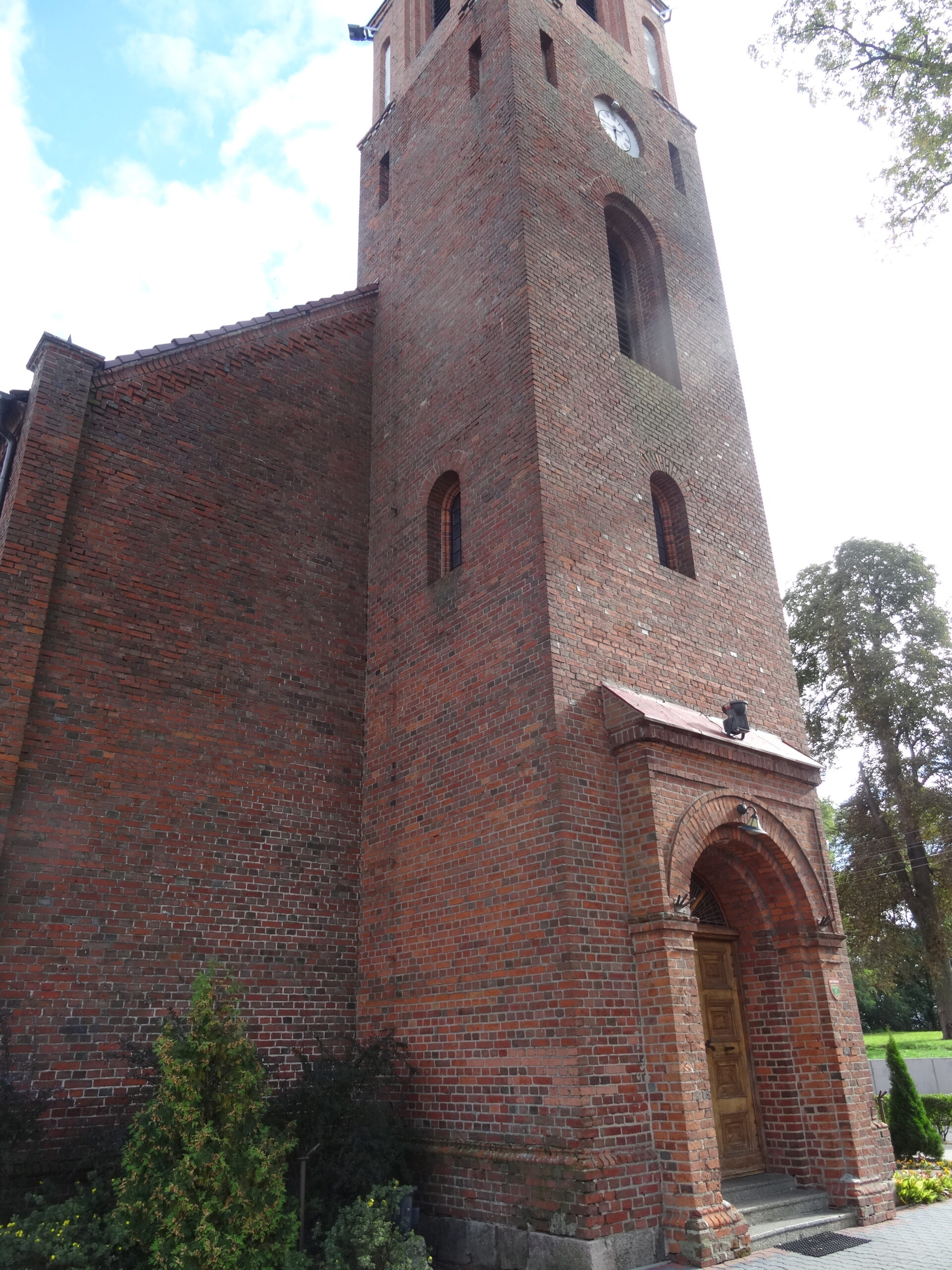
Abandoned Gramsdorf Evangelische Kirche built in 1865. Picture taken September, 2022 in Bukowiec.
In 1631 Bukowiec consisted of 20 houses belonging to the Starostei Rogasen (the Polish Royal Estate of Rogasen). An agreement with German immigrants for the settlement of Bukowiec was made in 1638. This agreement was finalized on November 1, 1641, when after years of legal disputes with Herr Grudzinski from Chodiez (Kolmar) the Starostei of Rogasen (the administrator of the district) Paul Sokolowski was awarded the village of Bukowiec.
There is conflict in the available resources as to the actual founding of the community. A commemorative publication dated June 19, 1885, celebrates the 250th anniversary of the Gramsdorf congregation. (Geschichte der evangelischen Kirchen-Gemeinde Gramsdorf. Festschrift zum 19 Juni 1885, zur Feier des 250-jährigen Bestehens der Gemeinde.) That would place the founding of the Gramsdorf church as 1635. The first reported Pastor of the congregation is Jakob Wilde or Wille who moved to Gramsdorf from Jankendorf after the former had been depopulated by the plague.
Following the 1641 agreement Paul Sokolowski sold the village to the brothers Thomas and Lukas Grams for 500 Gulden (Zloty). They also received 3 full farms of 20 Morgen each and a field of 10 Morgen. In return, they were required to take two-horse cartloads of goods twice per year 12 Meilen (approximately 50 US miles) or to Siersk. They were free from all other taxes, services, and burdens because the village was founded according to German law. All other villagers also enjoyed the same privileges.
The Grams brothers were required to settle 12 farmers, each of whom was to receive a strip of farmland of approximately 20 Morgen. Each farmer was to pay annually 15 Gulden (Zloty) of rent, give 2 chickens and a goose, and perform 10 days of other work as stipulated in the agreement from 1638. It was the responsibility of the Grams Brothers to collect these taxes and ensure that the duties were performed. The brothers were allowed to employ a sheperd and brew beer for their own use. The German villagers were guaranteed the right to hold religious services according to their faith.
Twenty years later in 1661 it is recorded that Peter Kuhn and Albert Meger and his son are Freischulzen with two Schulzengüter (farmsteads). They are required to deliver two cartloads of grain to Bromberg every year. The twelve free farmers in the village are each to pay 15 zloty of rent and 6 zloty 24 groschen in lieu of payments in kind. The four cottagers, including the blacksmith, each pay 2 zloty of rent. By this time Thomas and Lukas Grams have died. On September 26, 1662, King John Casimir confirms that Georg and Johann Grams are the successors to 1641 privilege granted to the original Grams brothers.
On February 9, 1672, King Michael again confirmed the privilege granted by Starost Paul Sokolowski to the successors of Thomas and Lukas Grams, namely Albert Meger and his wife Elisabeth Grams, their son Peter, and the brothers Johann and Peter Grams. The services required of the Schulzen and the farmers appointed by the deceased Grams’ brothers are the same as the 1661 privilege. The new Starost Michael Zebrzydowski sells the Schulzen Georg and Peter Grams surplus land, that they cleared without buying, for 200 zloty. They make a down payment of 93 zloty. The balance is to be paid by Martin Buschke, an innkeeper from Neudorf, after he received a debt payment from Mathias Zimber and Thomas Düwel from Gramsdorf by All Saints’ Day in 1672.
On July 8, 1714, Stephan Stanislaus Zebrzydowski-Sokolowski allowed Christoph Kant to buy for 2000 tinfe the Schulzengut from the descendants of the deceased Schulze Johann Grams. The children of Johann Grams are still minors. The children Johann, Peter an Käthe have guardians appointed for them. Schulzen Düwel from Tlukawy and Schulzen Jacob from Gramsdorf take custody of the children’s shares.
A legal dispute between the village and the Catholic clergy in Rogasen over the grain that was to be delivered to them developed prior to 1722. In that year the Pastor Thomas Schulz, who was the son of the second pastor, Michael Schulz, in response to the conflict secretly left Gramsdorf and became a pastor in Gründberg in Silesia. His replacement the following year, Martin Pilatzki, a son of a Schulzen near Czarnikau was fluent in Polish. He used his skill to mediate the disputes with the Catholic clergy.
On July 24, 1742, the church, likely 100 years old, burned down. Until a new church was completed in November, the congregation held its services outside. A special note was made by congregants at that time that the outdoors services were never interrupted by rain. The second church was made of wood which cost 2,570 ducats, some of which was raised with the support of the neighboring villages.
Following the end of the Seven Years’ War in 1763 the Polish-Lithuanian Commonwealth was weakened and became virtually a satellite state of Russia. On April 11, 1764, Empress Catherine the Great, along with Frederick II of Prussia arranged for the appointment of Catherine’s former lover Stanislaw August Poniatowski as the new king of Poland. The conservative catholic nobles objected to this subjugation, especially the new rules that were empowering non-Catholics. Between 1768 and 1772 a confederation of Polish nobles fought a war against the new government.
These troubles also struck Gramsdorf. Between 1768 and 1773 the fifth pastor, Samuel Gottlieb Benicke a native of Landsberg and his family were forced to flee the village several times ahead of the Polish Confederates. It was reported that the family lost all their possessions. It is also reported in the parish history that the community suffered severe persecution during this period from the Confederates.
The second church became dilapidated and had to be abandoned. On October 17, 1865, the congregation consecrated a new brick church. The third church, although abandoned, is still standing in the village of Bukowiec today.
Primary Sources
Quellenband zur Geschichte der zweiten deutschen Ostssiedlung im westlichen Netzegau, Werner Schulz, 1938
Geschichte der evangelischen Parochieen in der Provinz Posen, Albert Werner, 1898