
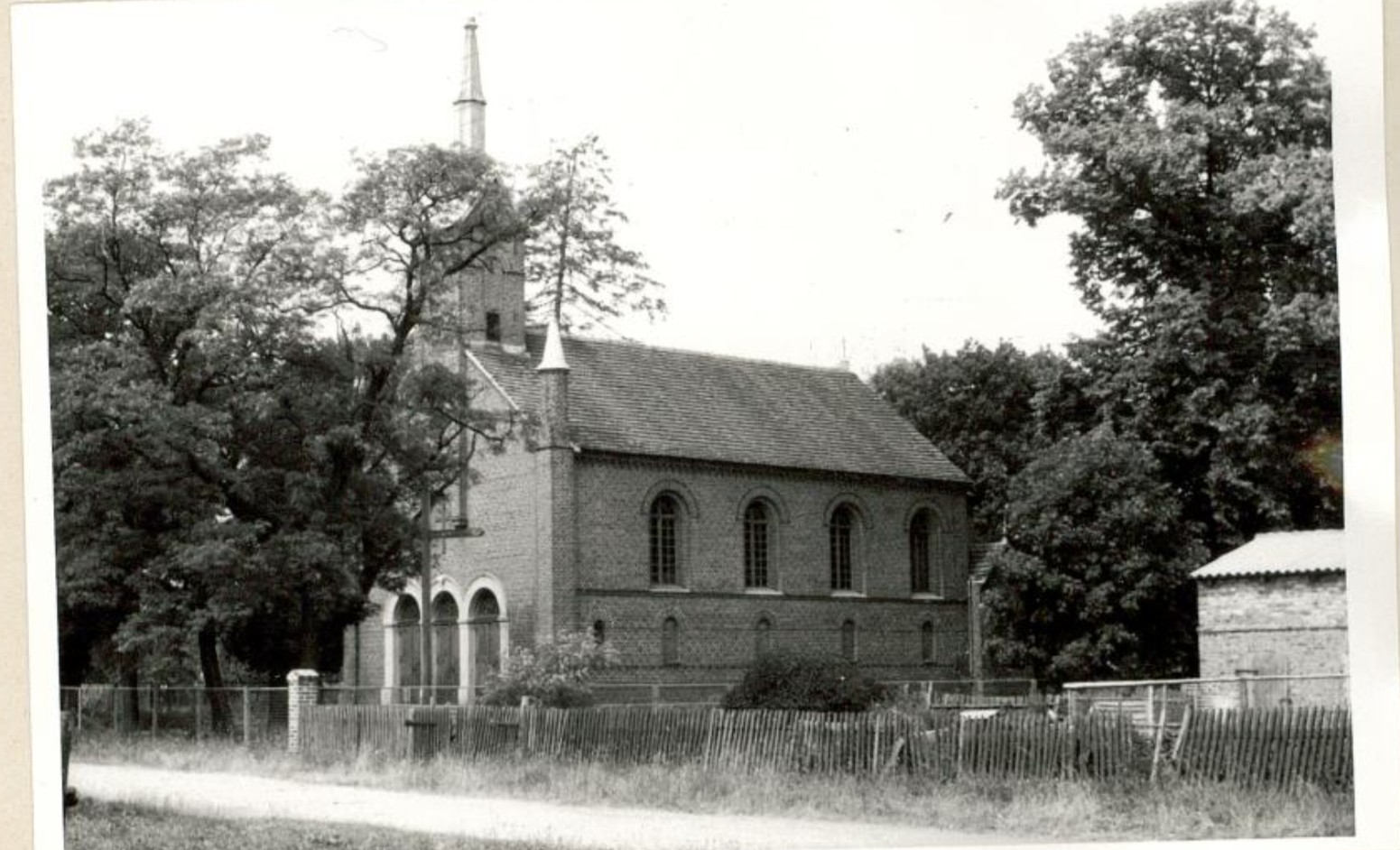
Jankendorf was a village formerly called Uta that was abandoned during the Swedish wars and plagues in the early 17th century. There is a tax list dating from the 16th century for the village of Uta. On October 19, 1629, Barbara Sokolowska, Castellan of Gostin and Starost of Rogasen instructed Daniel and Christoph Janken to establish a village in the place formerly called Uta or in Polish Sokolowo. The brothers were given two full farms for 500 zlotys and a third farm for two cottagers and 10 Morgen of Kampenland in each field. The Jankens were required to find 15 farmers, each of whom was to receive one full farm of 20 morgens each. Each farmer was required to pay the Polish authorities15 zloty, 31 groschen, 2 chickens and a goose plus perform 15 days of service, as well as another six days during hay harvest. The Schulze and the farmers were also required to provide a load of hay to Szierski. An innkeeper was to be appointed after payment of 150 zloty. The innkeeper was to receive 20 Morgen and be required to haul two cartloads 12 Meilen (approximately 50 US miles) annually. The Schulzen initially paid the purchase price for the tavern. All residents received 7 years of freedom. The Schulzen was allowed to brew beer eight times per year.
Barbara Sokolowska gave the Janken brothers and the other German settlers in the village the permission “to maintain a church and a pastor according to their religion and worship.” Records for founding of the church are not available however Albert Werner in his 1898 book “Geschichte der evangelischen Parochieen in der Provinz Posen” writes that it was thought that a church was built immediately. It was reported in the history of Gramsdorf parish that their first pastor Jakob Wilde moved to Gramsdorf from Jankendorf in 1635. The first recorded pastor for both parishes was Wilde followed by Michael Schulz from 1681 to 1699.
On February 10, 1670, King Michael confirmed that Ernst Kunkel and his son Martin were now the owners of the Schulzengut estate. Later on, January 14, 1682(year is unclear), Adam von Gorai Brez in an effort to prevent further devastation of the Schulzengut estate allowed Martin Radowski and his wife Anna nee Schmidt to sell half of the estate that the couple own. The estate that was sold comprised 1 ½ full farms and a field of five morgen. Urban Kunkel and his wife Helene purchased the estate for 750 Zloty. The Kunkel’s received the same rights as in the previous privilege. Martin Kunkel recorded the privilege of 1670 in the Deutsch-Kroner Grodbücher. Christopher Kunkel, on behalf of his father Urban recorded their privilege of 1682 at the same time in 1701.
The first recorded records of the Arndt family in Jankendorf were on May 1, 1707, when Georgius Mikolay v. Goray Breza approved of the purchase of the inn by Jakob Arndt. The previous owner, Johann Neumann, was deeply in debt and was forced to sell his inn to cover his debts. Jakob Arndt took over the inn as a freehold, meaning he was exempt from serving alcohol. He did receive the right to brew beer for his own household needs.
In the early 1700s, during the Great Northern War and the subsequent plague, the village of Jankendorf suffered greatly. On April 12, 1717, Adam Nikolaus von Gorai Breza permitted Urban Kunkel and his wife Elisabeth Arendt to sell their half of the Schulzengut estate to Stephan Arendt and his wife Dorote Gatzke for 1800 tinfe. It had been recorded that in recent years the whole village was deserted. The Schulze Kunkel had to make up for the loss of the tax revenue. Kunkel was forced to sell because of the heavy debt burden he was under.
It was not just the village finances that fell into hard times in the early 1700s but also the church. Following the exit of the second pastor Michael Schulz in 1699 and the appointment of Johann Bolte from Konitz in 1715 the congregation had 4 pastors in the 16-year span.
Jakob Schulz followed his father in the pulpit. Schulz was the brother of the pastor in Gramsdorf.
He was followed by Johann Gatzke who came from Prussia.
The next pastor Johann Friedrich Müller met a tragic fate. Müller a former Swedish military chaplain was hated by the Polish citizens of the area. On a trip to Posen, he was assassinated.
Following Müller’s murder Johann Straube from Frankfurt on the Oder was appointed.
The troubles for the village continued. Starost Adalbert Nikolaus von Gorai Breza gave his permission to Adam Kunkel, the son of the former Schulze Martin Kunkel, to purchase half of the Schulzengut estate from Paul Arendt on May 12, 1719. Arendt was to receive 1,000 zloty to reimburse him for repairing buildings and paying taxes for deserted properties. Before Arendt received his full payment the whole village burned down because of his negligence. He received no further payments while Kunkel received another half farm for a cottager to live free of taxes.
Johann Bolte’s appointment in 1715 did not bring stability to the congregation. The negligence of Paul Arendt that resulted in the village burning down included the first church. It was not until after Bolte’s 1741 death that the community was able to build a new church. In 1745, the community could only afford to build a wooden, low ceiling, barn-like structure. This humble building was used by the congregation until April 6, 1851, when a new church was consecrated. Today that building serves congregation of the Immaculate Heart of Mary in Sokolowo Budzynskie.
On May 9, 1731, with the permission of Georg Nikolaus von Gray Breza, Christian Kunkel bought the destroyed Schulzengut estate from his brother Peter for 2,000 tinfe plus an additional 500 tinfe to repair the buildings on the estate. Peter Kunkel was from Althütte and had purchased this Schulzengut from the widow of the former Schulze Stephan Arendt. Christian Kunkel purchased 1 ½ full farms, a half farm for cottagers and 5 Morgen of Kampenland in every field.
Following the death of Johann Bolte, and shortly thereafter his son Johann Daniel Bolte who served as his father’s adjunct, Carl Ehrenreich Thieme or Thyme was appointed pastor. He oversaw the building of the new church. At the time of the first partition in 1773 the village had been repopulated. In that year the village had 68 families, totaling 269 persons, all of whom were German living on 58 ½ full farms of 30 Morgen each. However, Thieme that year left the village to accept a call in Margonin.
Following Pastor Thieme leaving Jankendorf the congregation again had a series of pastors. Johann Friedrich Bort served until 1793 when he was dismissed. Then Friedrich Alexander Siewerth, from East Prussia served from 1793 to 1810.
Primary Sources
Quellenband zur Geschichte der zweiten deutschen Ostssiedlung im westlichen Netzegau, Werner Schulz, 1938
Geschichte der evangelischen Parochieen in der Provinz Posen, Albert Werner, 1898