
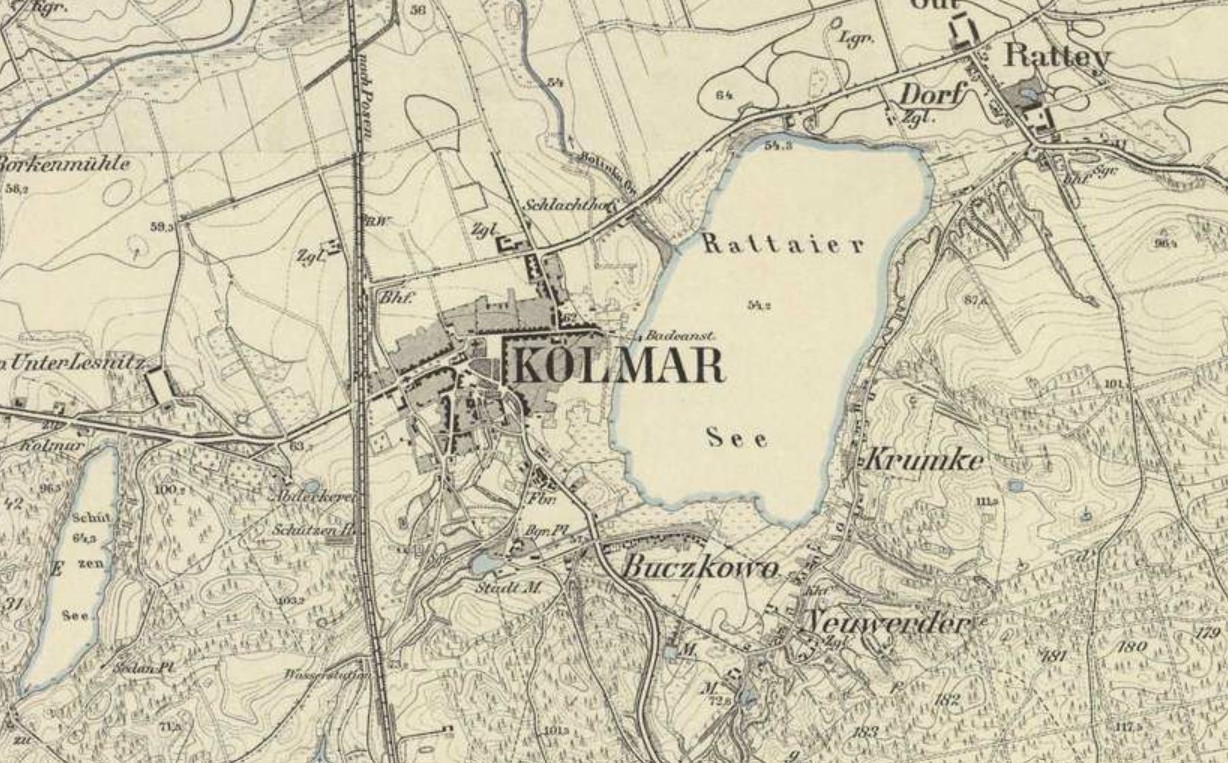
Prior to King Wladyslaw III of Poland (1424-1444) granting a privilege to Trojan of Lekno to charter Chodziez on March 3, 1434, there was already a castle and probably a village here. There are records that a Priest Jacob was living here in 1409.
The oldest town register contains a few distinctly German names of residents from the period 1511 to 1595. These earliest German families likely assimilated into Polish culture. During this period the town was owned by the Potulicki family. Following the reformation August Potulicki converted to Lutheranism and the local Catholic church included his believers. This continued into the beginning of the 17th Century when Johann Poulicki returned to Catholicism.
The second city book begins in 1679 containing a much larger percentage of German names. This likely means that a larger immigration of German families to Chodziez took place between 1633 and 1679. German family names found in these registers that are common in the Gembitz Hauland parish register include Reiter, Kelm, Doberstein, Sommerfeld, Manthey, Jesse, Kopp, Fechner, Heyn, Zimmermann and Krüger. These early German Lutheran immigrants traveled to Gramsdorf for worship. However, their baptisms and weddings were performed by a Catholic priest.
In 1648 the Grudzinksi family became the owners of Chodziez. This date may be in error as the Grudzinksi family is documented as settling a dispute with Starost of Rogasen prior in 1641 over the ownership of the village of Bukowiec (later Gramsdorf). In any event after the devastation of the Swedish Wars the Lord Grudzinski was a strong advocate for German immigration to rebuild his estate.
Following the first partition of Poland on August 5, 1772, Chodziez (Kolmer) became incorporated into of West Prussia. At that time 2/3 of the residents of Chodziez were of the Lutheran faith. Pastor Samuel Gottlieb Benicke began coming several times a year from Gramsdorf to conduct services and serve communion in private homes.
In 1774 Count Sigismund Grudzinski (1735-1804) granted the Lutheran residents of his city the right to build their own church on land that he donated. A wooden church was built. In 1776 a parsonage and garden were also purchased. Pastor Benicke remained the guest pastor until his death in 1778. On May 25, 1779, the Prussian royal government in Marienwerder recognized Kolmar as an independent parish. Andreas Christoph Krüger, born 1750 in Gornitz in Neumark, was appointed as the first pastor at that time.
The first church was damaged by a fire in 1780 and gradually fell into such disrepair that it was torn down in 1820. In 1825 the parish’s first pastor died and Carl Wilhelm Schultze (1792-1874) was appointed to replace him in 1826. Three years later a new church was built paid for by King Friedrich Wilhelm III. The building was consecrated on October 18, 1831.
The city of Chodziez (Kolmar) was an important market for the farmers of the area. Market day was on Fridays. Families came from the surrounding area to trade their goods. If there was no urgent work to do on their farms they would stay and socialize. This is likely why many people were able to find spouses in villages relatively far when traveling by horse from their homes.
Primary Sources
Quellenband zur Geschichte der zweiten deutschen Ostssiedlung im westlichen Netzegau, Werner Schulz, 1938
Geschichte der evangelischen Parochieen in der Provinz Posen, Albert Werner, 1898