
| Document | Indentifier |
|---|---|
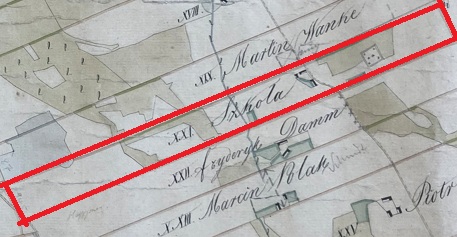
| Preibisch Survey | XXI |
| Preibisch Survey Owner | Community |
| Rezess Contract Owner | Community |
| First Land Record Owner | Community |
| 1830 Blatt Number | 12 |
| 1864 Property Tax Number | 12 |
| 1921 Community Register House Number | 22 |
| Estimated Current Address | Gebicyzn 22 |
The School Property
On the Preibisch Survey map property number XXI is the one half of the full farm reserved in 1735 by Nikolaus von Mielecki, the hereditary lord of Gembitz for his German settlers to maintain a school, a prayer house and a cemetery. In the original contract a full farm had been reserved as the school property. After Martin von Radom Radomski granted his new privilege to the community in the 1744 contract, this property was reduced in size to 15 kulmischen Morgen. This land was farmed rent free by the community and the teacher to support the teacher’s family.
The Church

In 1780 the community built on the school property a prayer house that was also used as a school, a home for the teacher and a community center. This building burnt in 1814 and a half-timbered building was built to replace it.
In 1856 the second prayer house became the parish church for the communities of Gembitzhauland, Polajewohauland, Niewiemko, and Glasshütte when the Gembitz parish was split from the mother church in Gramsdorf. On July 11, 1893 this church also burnt down.
Services were held in the school until a new brick church was able to be built across the road in front of the first cemetery. For a parish of 800 congregates building the new church was very difficult. To complete the building the community needed government funding and strong support from the Gustav-Adolf-Verein. The Gustav-Adolf-Verein was a German Protestant organization organized to support Protestant communities to build churches and schools in predominantly Catholic regions. The small brick church with seating for 240 people and an organ with 8 sounding stops (pneumatic) was dedicated November 16, 1900. Empress Auguste Viktoria donated the altar Bible with a handwritten dedication: “Set your minds on things above, not on earthly things!” (Colossians 3:2).
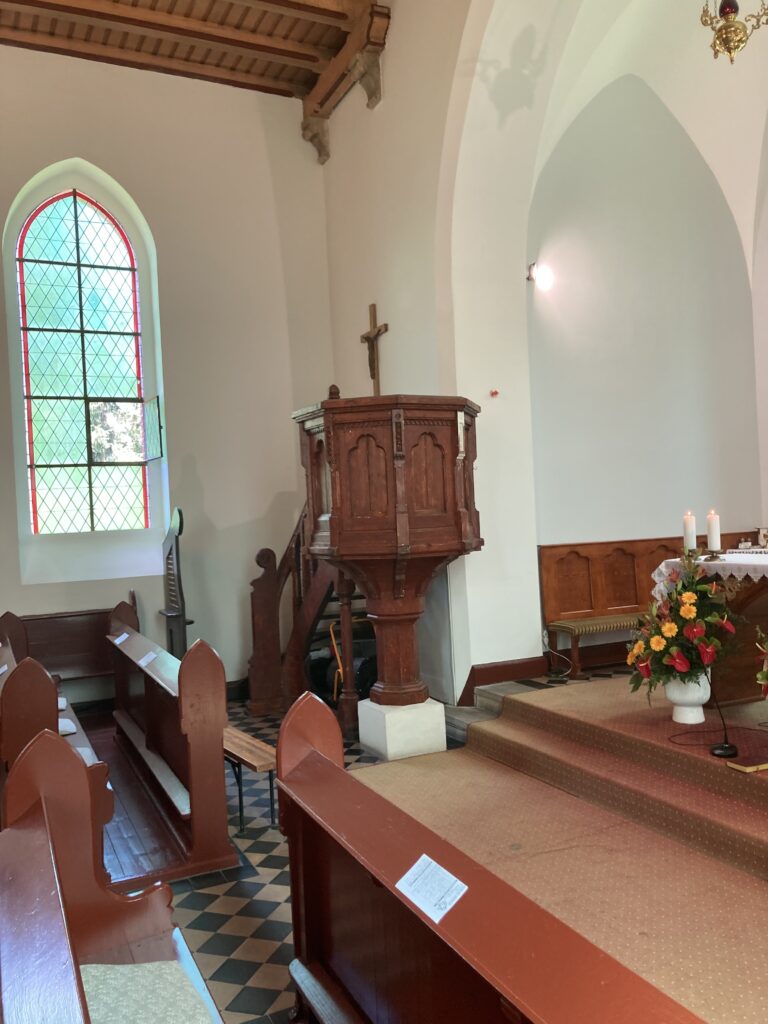
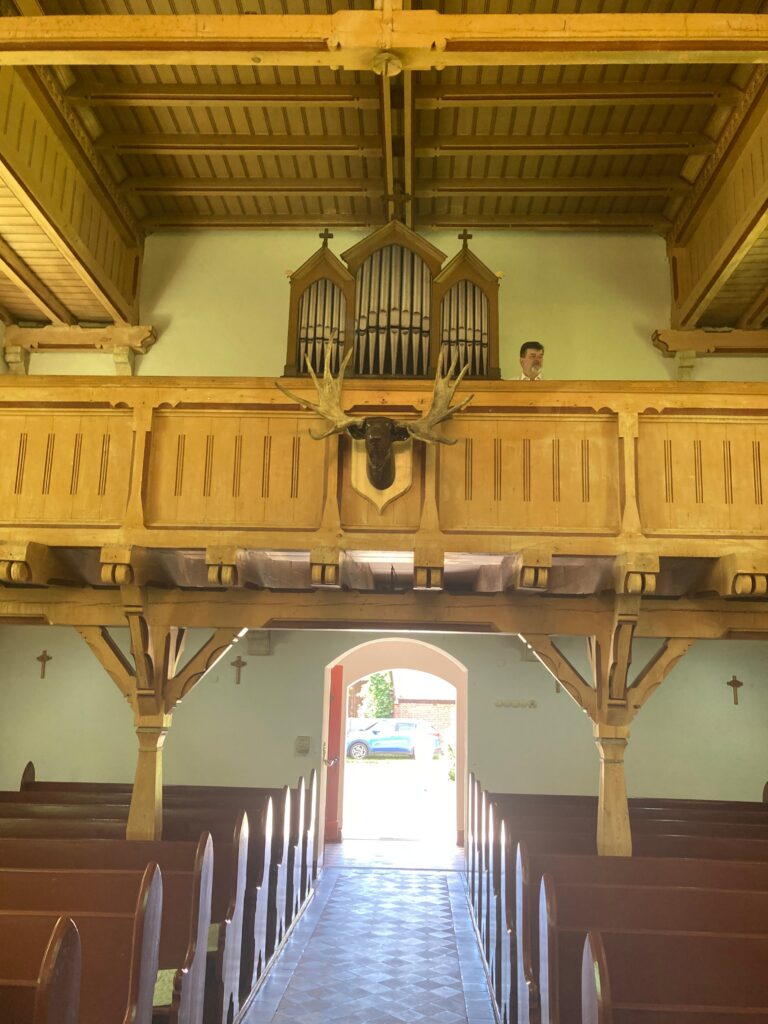
Today this third church is an active Catholic congregation in Gebiczyn.
The Bells
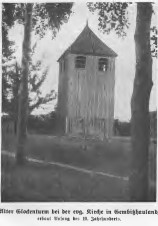
In 1835 King Friedrich Wilhelm IV donated two bells to the community. Later one of the bells was replaced by a third larger bell. A bell tower to house the bells was built on the community property. This bell tower stood until at least the 1950s when it fell into disrepair and was torn down. Today one of the bells still hangs on an iron tower southwest of the church door proudly rung on special occasion by the Polish residents of Gebiczyn.

The School
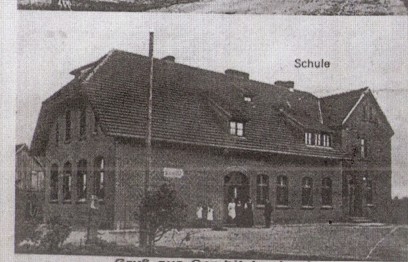
The School from early 1900s. Image from an old postcard.
A separate school was built in 1848. The building had a classroom and an apartment for the teacher. Later when a second teacher was added an addition was made to the building consisting of another classroom and a second apartment. By 1906 the original school was in such disrepair that it was making the teacher’s wife sick. The building was torn down, and a new school was built and dedicated in 1908. The addition and the 1908 building are used as a home today.
The Cemeteries
A plot of land for the burial for the residents was reserved on the far east end of the school property. This cemetery was used until the 1860s when it became full. This cemetery is directly behind the current church. Today it is overgrown with brush and trees and there are no visible signs of any graves.
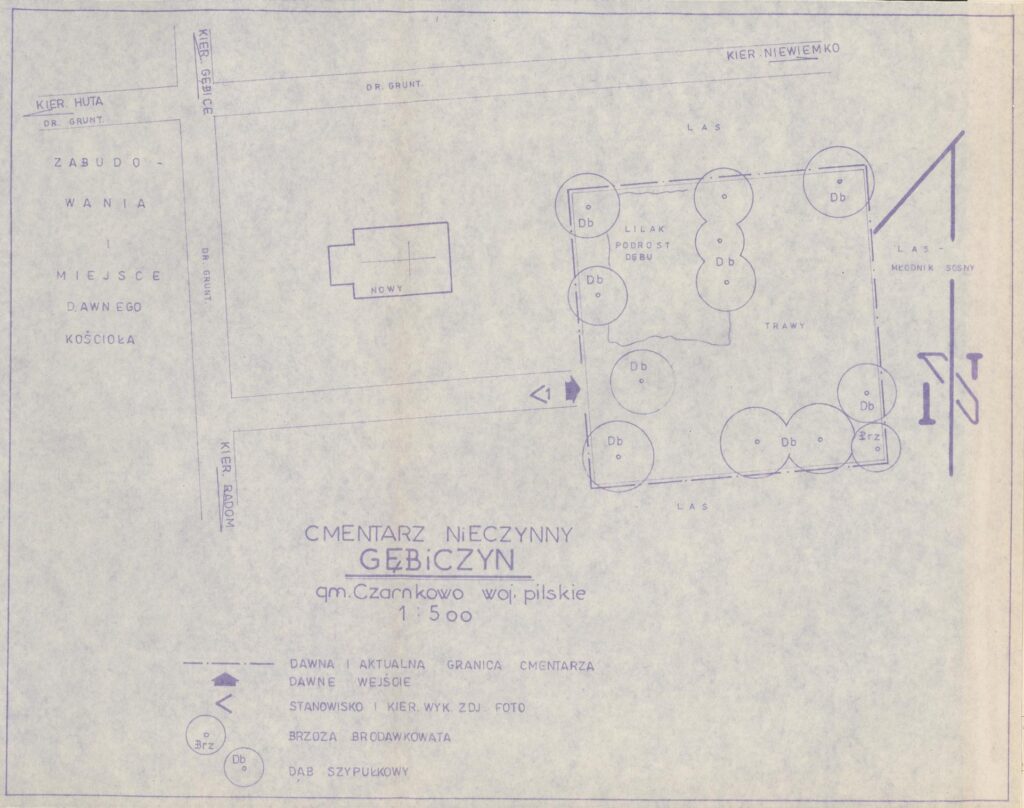
Location of the first cemetery 1988.
A new cemetery was plotted in 1866 on the far west end of the school property. Today it is in disrepair but with many graves still visible.
Begräbnis-Platz der evangelischen Gemeinde zu Gembitz-Hauland
Teachers
Johann Daniel Reiter was the teacher in the community at the time of the birth of his daughter Johanna Susanna Reiter on July 19, 1816. Daniel Reiter married Dorothea Elisabeth Wanke. The couple lived in Gembitzhauland until at least the birth of their son Friedrich Michael Reiter on March 22, 1830. The couple had three other children, Gottlob Samuel (1818-1887), Dorothea Elisabeth (born 1825), and Christian (1826-1910). All the children except Johanna Susanna later lived and were married in the area of Zachsberg, Kreis Kolmar and Margonin, Kreis Kolmar.
The three sons emigrated to Farmington Township, Olmsted County Minnesota. Obituaries and oral family histories state that the children of Daniel Reiter were cousins of the children of Gottlob Reiter who had married Anne Justine Scheffler, the daughter of the former owner of Farm 10.
Paul Dams was born in Tütz, Kreis Deutsch-Krone May 8, 1874. After studying in Bromberg, he came to Gembitzhauland as the second teacher in March 1894. In addition to being the teacher he was also the cantor for the church. On May 23, 1899, he married Ottilie Emma Kelm (born 1878), the daughter of August and Ottilie Petersdorf Kelm. August Kelm was the teacher in Wischinhauland. Paul and Emma Dams’ had four children in Gembitzhauland. The family stayed in Gembitzhauland until 1922 when he accepted a position in Wenden, Kreis Rastenburg in East Prussia.
In 1954 after being forced to flee East Prussia he wrote his memoir in a series of notebooks. These handwritten notebooks have been transcribed by his great-great-grandson. The information from that memoir is a primary source for much of the information on this page.
Paul Dams died suddenly on February 23, 1955, with his memoir unfinished.
Building Register June 1, 1907
The property consisted of a house with a schoolroom, a combination cattle and pig barn, a barn and a woodshed.
Community Register 1921 – 1933
When the community register is created after Gembitzhauland (now Gebiczyn) becomes part of Poland, the school is now house number 22.
With Gembitzhauland now part of Poland Paul Dams and his family decided to remain German citizens and moved to Wenden, Konigsberg, East Prussia. To replace him Friedrich Jesse (born 1897) moved with his wife Sophia nee Degner (born 1898) and his mother Martha nee Hundt (born 1869) to Gebiczyn on May 1, 1922. Jesse continued as the teacher in the school through at least 1943.