
| Document | Indentifier |
|---|---|
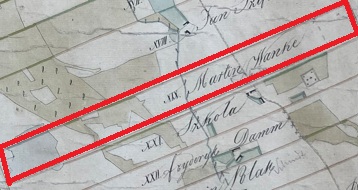
| Preibisch Survey | XIX |
| Preibisch Survey Owner | Martin Wanke |
| Rezess Contract Owner | Martin Wanke |
| First Land Record Owner | Martin Wanke |
| 1830 Blatt Number | 11 |
| 1864 Property Tax Number | 11A |
| 1921 Community Register House Number | 19 |
| Estimated Current Address | Gebiczyn 19 |
The Krüg
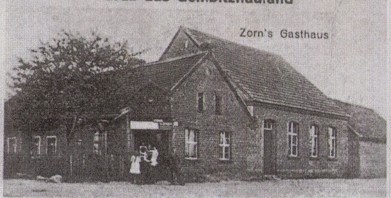
The Gasthaus from early 1900s. Image from an old postcard.
The histories of neighboring communities in Werner Schulz’ 1938 book “Quellenband zur Geschichte der zweiten deutschen Ostsiedlung im wetlichen Netzegau” describe that the granting of the privilege by the Polish landlord to operate the Krüg was the second highest special privilege, after Schulzen, that was offered to a German settler. While no records are available concerning who this privilege was originally granted in Gembitzhauland the complicated inheritance records for the Wanke family described in Farm 11 suggest that by the late 1700s this privilege was a major source of the family’s wealth and influence within the community and was jealously guarded.
On the Preibisch Survey map property number XIX is the ½ farm reserved in 1735 by Nikolaus von Mielecki, the hereditary lord of Gembitz for the Krüg where he was entitled to personal beverage rights of beer and brandy in the community. In the original contract a full farm had been reserved for the Krüg. The proprietor was allowed to keep up to 100 sheep. After Martin von Radom Radomski granted his new privilege to the community in the 1744 contract, this property was reduced in size to a ½ farm with free rent for the proprietor. After the Recess Contract of 1831 the Krüg was owned by Martin Wanke for which he now paid a rent. In this contract the residents of the community were no longer required to buy their beverages from the Krug. Likely overtime the value of owning the Krüg decreased which was why after the death of his father, Gottlieb Wanke sold the property. In the 1860’s the new owner of Farm 11, August Wendlandt, divided the property and the Krüg became Farm 11A.
Land Records
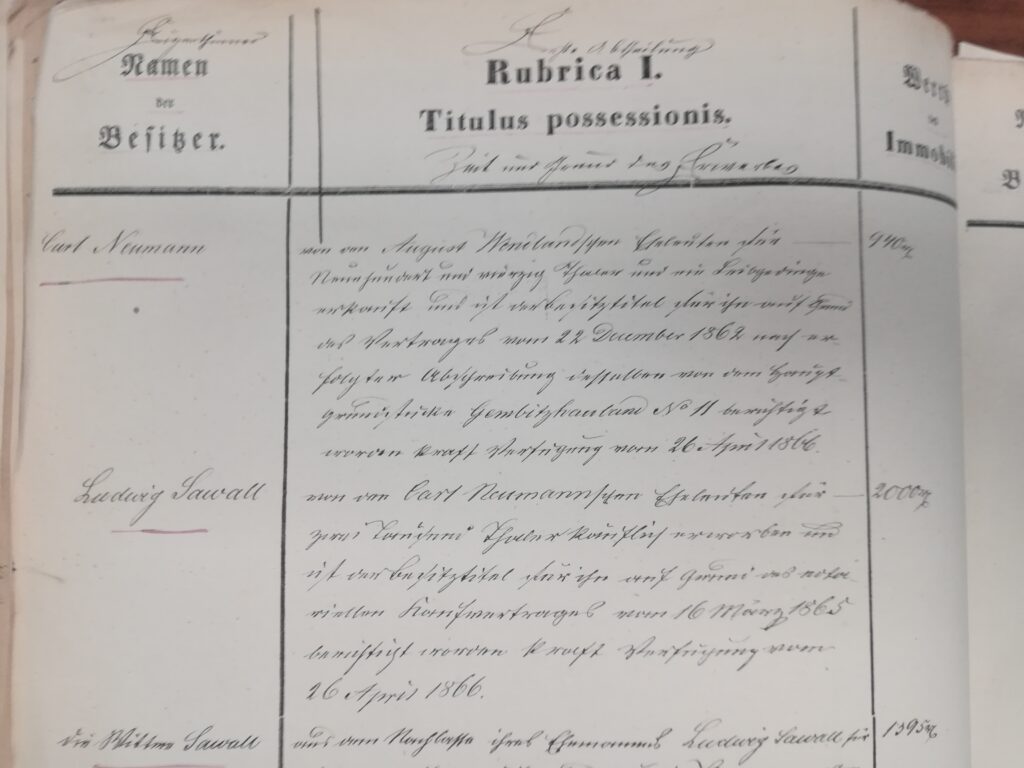
Karl Neumann purchased the Inn from August Wendland, the owner of Farm 11, for 940 thaler and a life estate. His title was confirmed pursuant to the contract of December 22, 1862.
Ludwig Sawall purchased the property from the married couple Karl Neumann for 2,000 thalers. The title of the property was transferred to him pursuant to the notarized deed of sale dated March 16, 1865, by virtue of an order dated April 26, 1866.
Ludwig Sawall (1820-1866) was the owner of Farm 32. He died on January 8, 1866, at which time his wife Anne Christine nee Krüger inherited Farm 11A.
Rentenkataster 1855 – 1920
- Karl Neumann
- Eduard Lüdke
- Julius Strutzberg
Karl Neumann was married to Louise Schulz. Between 1863 and 1865 the couple had two daughters in Gembitzhauland. No primary source records have been found for the couple before the birth of a daughter Emilie in 1850 and after the death of their youngest daughter Marie Bertha in 1865.
Eduard Lüdke (born 1827) married Justina Julianne Stolz (born 1834) on February 13, 1856, in Kreis Kolmar. At the time of their marriage Eduard was living in Sarben Kreis Kolmar and Justina was living in Strozewohauland. Their oldest daughter was born in 1859 in Sarben. Their only child born in Gembitzhauland was Auguste Bertha in 1868.
Julius Strutzberg was married to Louise Neumann. The couple moved to Gembitzhauland before 1882 when their daughter Albertine Olga was born. Prior to that the couple had at least six children in the neighboring communities of Kahlstadt and Briesen. In addition to the Inn Strutzberg also was the owner of Farm 10.
Property Tax 1863-1865
Carl Neuman is listed in the record as an Innkeeper for property number 11A.
Church Affairs and Parish Tax 1876- 1879
For each of the four years Eduard Lüdtke is recorded as the owner of the Inn paying 9 Marks of Klassenteuer each year.
Building Register July 31, 1890
Julius Strutzberg is the owner of the property.
Building Register June 1, 1907
On June 1, 1907, Hugo Beutler a businessman from Czarnikau is listed as the owner of the buildings. He was born February 6, 1881, in Czarnikau to Lesser and Marie nee Kaspari Beutler. He died in a concentration camp in 1942.
However, there is a note that Julius Strutzberg is still a resident of the community and still has financial stake in the Inn. The property consists of six buildings: a house and guest house (hotel), a cellar, a barn, a combination cattle and guest barn, a combination horse and pig barn and a wood barn.
On September 2, 1908, Adolf Rudolph Ludwig (1871-1950) and his wife Amanda Rach (1875-1955) are listed as the owners of the Inn.
Community Register 1921 – 1933
When the community register is created after Gembitzhauland (now Gebiczyn) becomes part of Poland, former Farm 11A is now house number 19.
Prior to Gembitzhauland becoming Gebiczyn the Inn was owned by Otto Hermann Zorn (1882-1959). He was married to Amanda Meta Dahlke (1894-1945) the daughter of Albert Gustav Dahlke and Emma Emilie Raatz the owner of Property 5 in Polajewohauland. Paul Dams in his memoir writes that following Gembitzhauland becoming part of Poland Zorn decided to move to Eichfier, Deutsche Krone. He also writes that the property was owned by Beutler from Czarnikau.
Between 1921 and 1925 no Innkeeper is recorded in the Community Register. On October 1, 1925, Franz Grams (born 1882) registered with his wife and son as residents of Gebiczyn. His occupation is listed as Innkeepper. Previously the couple had lived in Mikolajewo, Kreis Czarnikau. The family moved to Lowowek Powait Nowy Tomsysl (German – Lwow, Kreis Neutomischel) on October 13, 1928. Leon Grams moved with his wife and five children to Gebiczyn on April 17, 1928, to operate the Inn. The family previously had been living in Czarnkow.